
Studying the Buddha’s Words

The Middle Length Discourses of the Buddha

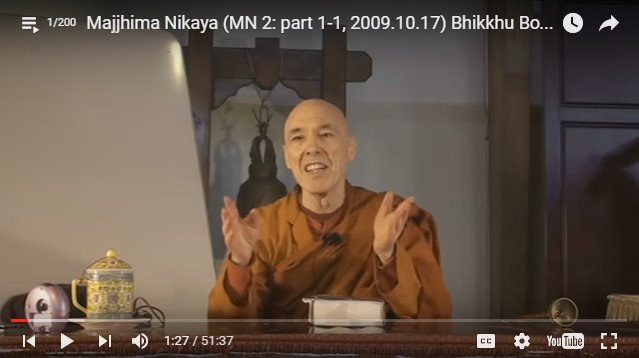
A Course in the Majjhima Nikaya with Ven. Bhikkhu Bodhi

This ongoing course offers the opportunity to study the Majjhima Nikaya with one of the co-translators of the influential English translation, The Middle Length Discourses of the Buddha (Wisdom Publications). The class starts at 9:00 am with an hour silent meditation. This is followed at 10 am by a talk on a sutta, with time for questions. A discussion period led by the teacher will be held after lunch, from noon to 12:30 pm. Newcomers are welcome.

Schedule for May through July 2013:

Date Sutta No. Sutta Title Main Topic
May 18th 95 With Canki How to realize the truth
May 25th 97 & 99 Dhananjani Sutta & Subha Sutta The role of the brahmavihāras
June 1st 101 At Devadaha How is striving fruitful?
June 15th 103 & 104 (&& 1-11, 21-22) Kinti Sutta & Samagama Sutta Ensuring the Dhamma lasts long
June 22nd 105 Sunakkhatta Sutta Training without misconceptions
June 29th 108 Gopakamoggallana Sutta After the Buddha’s passing
July 13th 109 Long Discourse on Full-Moon Night – 1 On the five aggregates
July 20th 109 Long Discourse on Full-Moon Night – 2 On the five aggregates
July 27th 110 Short Discourse on Full-Moon Night On good & bad conduct

Online Class (Live TV) / Past Classes Video Clips

Reference Material: (1) Basic Meditation Guidance ; (2) Sharing the Merits

Continue Reading…

Add a comment

Great Buddha (Buddha Vairocana)

In the Mahayana doctrine of the threefold bodies of the Buddha, Vairocana is the cosmic embodiment of the historical Buddha. Of the three bodies, Vairocana is regarded as the highest form, a god of light whose reflection throughout the universe is represented as endless. His wisdom is the wisdom of the Dharmadhatu. The Dharmadhatu is the realm of truth in which all things exist as they really are. Vairocana’s wisdom is also referred to as the all-pervading wisdom of the dharmadhatu, the absolute Buddha-nature.

In paintings, Vairocana is colored in white to symbolize a pure consciousness. As the supreme Buddha, his characteristic gesture is the mudra of the six elements in which the index finger of the left hand is clasped by the five fingers of the right, symbolizing the uniting of the five elements of the material world (earth, water, fire, air and ether) with the spiritual consciousness.

Add a comment